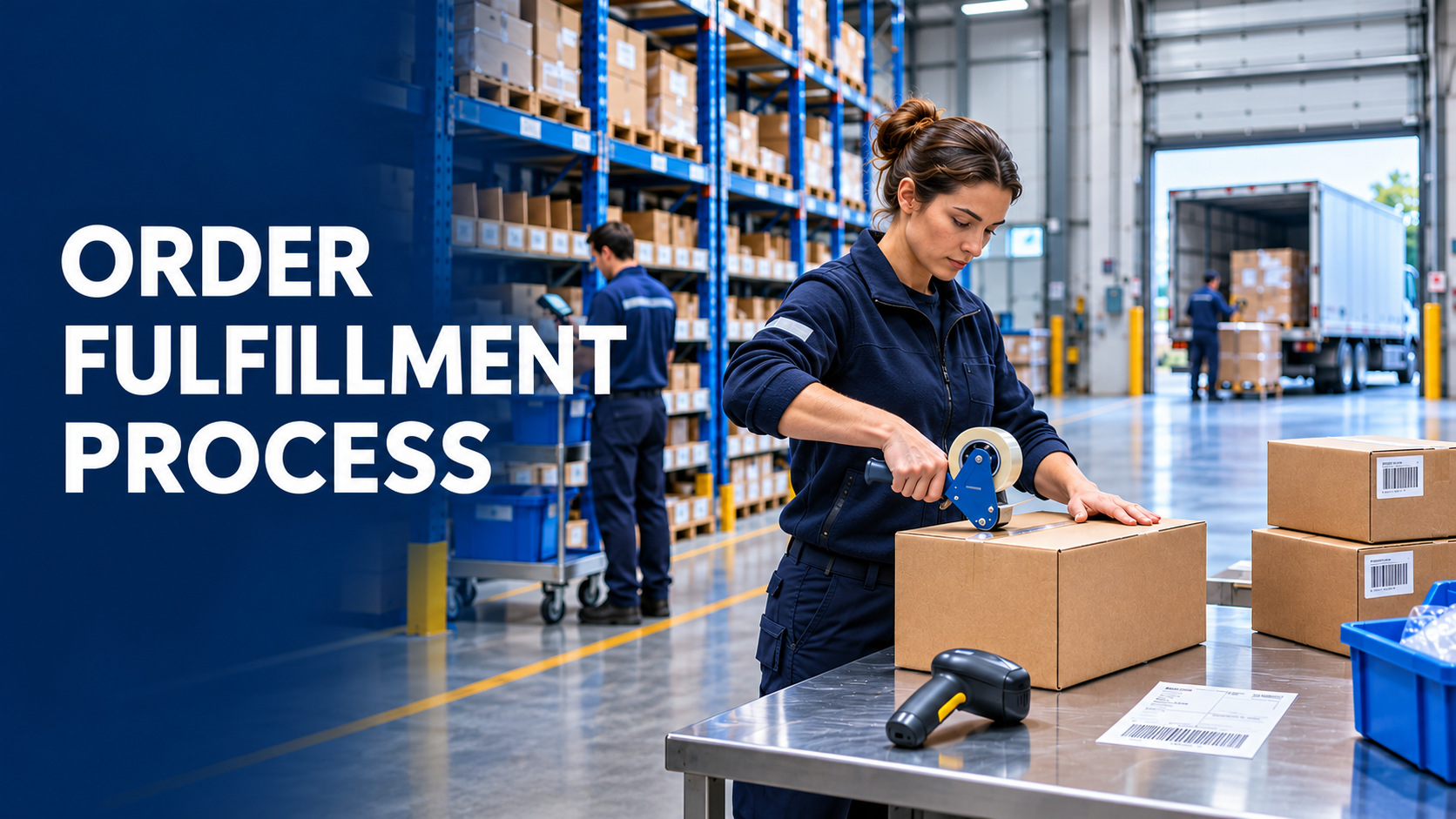
Order Fulfillment Process
Order fulfillment covers every step between a customer placing an order and receiving it, and it often decides whether that customer orders again.
A pallet that arrives a day late costs more than the freight bill. One miscount at the receiving dock or one short-shipped pallet can mean a missed delivery window and a customer who starts calling other suppliers. This guide covers what fulfillment means, how each step works, and how to measure the results.
Key Takeaways
- Dock to doorstep: fulfillment covers receiving and storing stock, picking and packing orders, and delivering them.
- Same steps, different units: single pieces for ecommerce, cases and pallets for B2B and retail.
- One inventory, every channel: omnichannel fulfillment fills orders from every sales channel out of one shared inventory.
- Fewer handoffs: slot fast movers near the dock and keep storage and delivery with one provider.
- Measure every order: your fulfillment rate shows how many orders ship complete.
What Is Order Fulfillment?
Order fulfillment is every step a business takes to get an order from its inventory to its customer: receiving and storing stock, processing the order, picking and packing, and delivering it. Payment starts a sale, but only fulfillment can complete the transaction by putting the goods in the customer’s hands. Put simply, the meaning of order fulfillment is that the right order arrives in the right quantity and condition, when the customer expects it.
On a tracking page, “fulfilled” can mean different things. On most ecommerce platforms, an order counts as fulfilled once all items in the order have been shipped, and sellers mark it complete only when delivery occurs. For a B2B shipper, that gap matters: an order fulfilled in the system can still be on a truck or waiting at a cross-dock. When one company runs both the warehouse and the trucks, the same team keeps the order until proof of delivery closes it.
Order Fulfillment Process Steps
Most order fulfillment guides count anywhere from five to eight steps, but almost every warehouse follows the same sequence.
1. Receiving
The warehouse team counts inbound freight against the purchase order and checks it for damage as it comes off the truck. A miscount at the dock turns into a short shipment later.
2. Storage
Each item goes to a set rack or bin location so pickers can find it again. Fast movers sit closest to the shipping dock.
3. Order Processing
The order arrives by website, email, phone, or electronic data interchange (EDI). The system checks it against available stock and turns it into a pick list.
4. Picking
Pickers pull the items from their locations by the piece, the case, or the full pallet. This is the most expensive step: a 2007–2022 review of order picking research finds that picking usually accounts for more than 55% of total warehouse cost.
5. Packing
Packers box and protect each piece. For B2B orders, the team builds pallets and stretch-wraps them at the dock.
6. Shipping and Delivery
The driver loads the order against its bill of lading and completes the last mile delivery, ending with proof of delivery.
Ecommerce vs. B2B and Retail Fulfillment
The steps remain the same for every order. What changes from channel to channel is the order size, the unit you pick, and where delivery ends.
What Is Fulfillment in Ecommerce?
Ecommerce, or direct-to-consumer (D2C), fulfillment ships online orders one customer at a time. In the ecommerce order fulfillment process, every order gets picked by the piece and tracked from checkout. The channel keeps growing: ecommerce made up 17.9% of US retail sales in the third quarter of 2026, according to the U.S. Census Bureau.
B2B Fulfillment
B2B orders are fewer and larger: cases or full pallets shipped to another business against a purchase order, often into a set delivery window. Accuracy weighs as much as speed because one short pallet can stall a job site or leave a shelf empty.
The Meaning of Fulfillment in Retail
In retail, fulfillment means keeping stores stocked: a warehouse replenishes each location on a regular schedule. Many retailers also fill online orders from store stock, which is where omnichannel comes in.
| Ecommerce (D2C) | B2B | Retail stores | |
|---|---|---|---|
| Typical order | A few pieces | Cases or full pallets | Mixed cases for one store |
| Picked by | Piece | Case or pallet | Case |
| Delivered to | A home | A business dock or job site | A store’s back room |
| What matters most | Speed and tracking | Accuracy and delivery windows | A steady, predictable schedule |
What Is Omnichannel Fulfillment?
Omnichannel fulfillment fills orders from every sales channel (website, marketplace, store, sales rep, or wholesale account) out of one shared view of inventory. A business can ship an online order from its nearest store, or a wholesale order from the same stock that serves its website. It is not only a retail practice: in MIT’s omnichannel supply chain research, 78% of wholesale and 74% of manufacturing respondents were already implementing an omnichannel strategy.
Order Fulfillment Strategies That Keep Orders Moving
These strategies work whether you ship pallets or parcels:
- Choose a model. Fulfill in-house, outsource to a warehouse partner, or mix the two, depending on how much time fulfillment takes away from selling.
- Slot fast movers. Keep your top sellers near the dock so each pick path stays short.
- Count every piece. Regular cycle counts catch errors before they turn into short shipments and stockouts.
- Store near customers. Shorter delivery routes mean faster arrivals and lower freight costs.
- Cut handoffs. Every transfer between a warehouse and a separate carrier adds a wait and another place for freight to go missing.
How to Calculate Your Order Fulfillment Rate
Your order fulfillment rate shows how many orders you ship complete. It is the quickest health check for any fulfillment operation.
Order fulfillment rate = (orders shipped complete ÷ total orders received) × 100
If you receive 1,000 orders in a month and ship 980 complete, your rate is 98%.
The rate measures completeness, not whether those orders arrived on time and undamaged. Many shippers also measure on-time, in-full (OTIF) delivery and order accuracy, or combine them into a perfect order rate. That bar is higher than it looks: KPMG’s analysis of perfect order performance shows that if five order dimensions each perform at 95%, the combined perfect order rate falls to about 77%.
How SFC Handles Fulfillment in South Florida
Specialized Freight Carriers (SFC) is an asset-based less-than-truckload (LTL) carrier with its own warehouse in Weston, in West Broward. Because one company handles every step, there is no handoff between a warehouse and a separate carrier. One team is accountable for your freight from receiving to delivery:
- Receiving and inventory: our team unloads trucks and containers from the Port of Miami, then tracks every item down to the single piece.
- Picking and packing: about 70% of our warehouse work is B2B, mostly pallet in, pallet out. The other 30% is D2C pick and pack, from tile delivered to the end user to turf cut to order and delivered the next day.
- Kitting: our kitting and assembly team builds food and hygiene kits, close to 1,000 boxes a day.
- Delivery: 35 local trucks run from Port St. Lucie to Key West, including daily retail store deliveries from the Keys to Vero Beach. Trucks also leave nightly for New York and New Jersey, with 2-3 day transit.
Our warehouse is open Monday through Friday, 5 a.m. to 8 p.m., with after-hours service when an order cannot wait, and a 90-minute turnaround on urgent hospital equipment runs.
Specialized Freight Carriers is an owner-run company that has grown from a 2,500-square-foot warehouse to 115,000 square feet through word of mouth. The owners still talk to every new customer. As they put it, “Every customer has our cell numbers.”
When your orders need something new, we work out how to make it happen.
Ready to Have SFC Handle Your Order Fulfillment?
With Specialized Freight Carriers, the same team stores, picks, and delivers your freight across South Florida and to New York and New Jersey. Share what you ship and where it needs to go, and the SFC team will prepare a quote. Prefer to talk it through first? Call 1(833) SHIP SFC.
Order Fulfillment Process FAQs
What is the difference between order fulfillment and shipping?
Shipping is the transport leg: moving the order from the warehouse to the customer. Order fulfillment covers that leg plus everything before it, from receiving and storage to order processing, picking, and packing.
What is the first step in the order fulfillment process?
Receiving. The warehouse team counts inbound freight against the purchase order and checks it for damage before storing it. Errors caught at the dock are cheap to fix, while errors missed there follow every order.
Can one company handle both warehousing and delivery?
Yes. An asset-based carrier with its own warehouse stores, picks, and delivers orders on its own trucks, with no handoff to an outside carrier. SFC does this from its Weston warehouse, with deliveries across South Florida and nightly trucks to New York and New Jersey.